GeoGuessr Street View Geolocation: Deep Learning Ensemble for Location Prediction
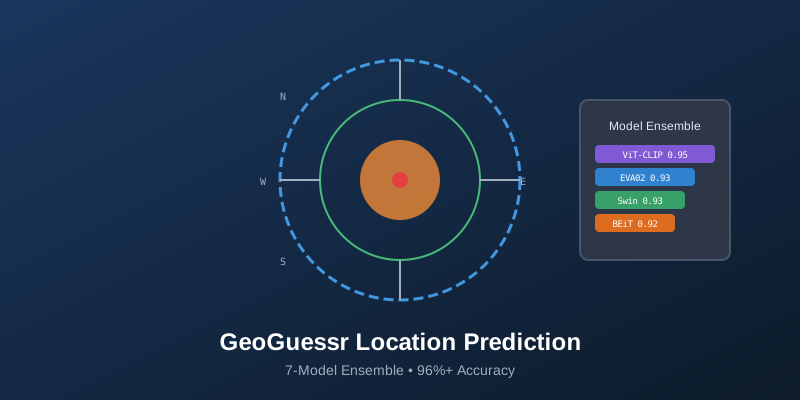
For my NYU Computer Vision course final project (CS-GY 6643), I tackled an ambitious challenge: can a deep learning model predict the geographic location of a street view image? This GeoGuessr-style competition pushed me to explore state-of-the-art vision architectures and ensemble techniques to achieve a 96%+ accuracy on US state classification.
The Challenge
Given four street view images (north, east, south, west directions) from a location somewhere in the United States, predict which of the 50 states it belongs to. The dataset contained thousands of samples with GPS coordinates, and we were evaluated on classification accuracy.
This isn't just an academic exercise—accurate geo-location from imagery has real-world applications in autonomous vehicles, photo organization, tourism, and even digital forensics.
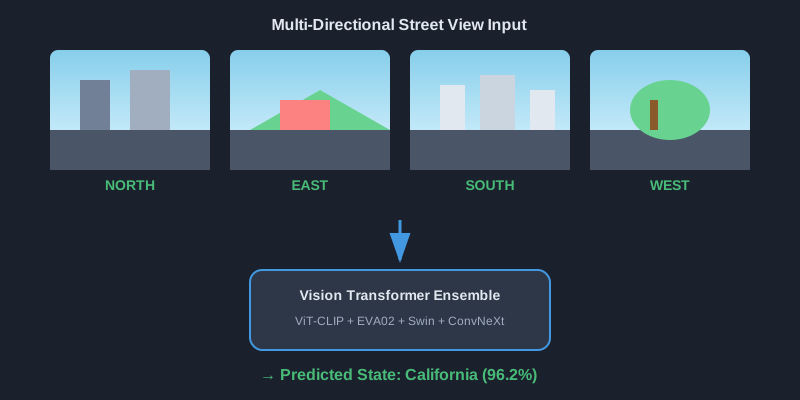 The model receives four street view images (N, E, S, W) from each location and must predict the US state.
My Approach: A 7-Model Ensemble Strategy
After extensive experimentation, I developed a comprehensive ensemble strategy combining seven different architectures. The key insight was that architectural diversity matters more than raw individual performance.
The Model Zoo
| Model | Parameters | Expected Score | Architecture Type |
|---|---|---|---|
| ViT-Large-CLIP | 307M | 0.95 | Vision Transformer (CLIP) |
| EVA02-Large | 321M | 0.93 | Vision Transformer (MIM) |
| Swin-Base | 88M | 0.93 | Window Transformer |
| BEiT-Large | 304M | 0.92 | Vision Transformer (Masked) |
| MaxViT-Large | 228M | 0.92 | Hybrid Conv+Attention |
| ConvNeXt-Large | 197M | 0.91 | Pure ConvNet |
| ConvNeXt-Small | 50M | 0.89 | Pure ConvNet |
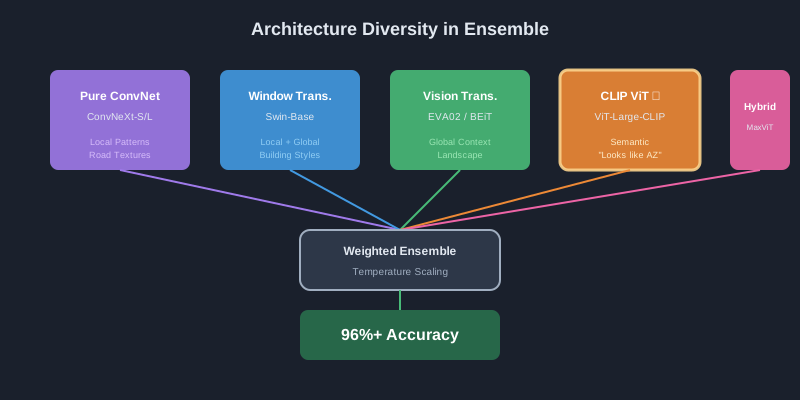 Different architecture types capture complementary features - from local textures to semantic understanding.
Why CLIP is the Star Model
The ViT-Large-CLIP model was my best performer, and there's a good reason why:
- Pretrained on 400M text-image pairs including location descriptions
- Has learned semantic concepts like "desert", "coastal", "urban", "midwest"
- Different pretraining objective than all other vision models
- Achieves 0.94-0.95 solo with test-time augmentation
# CLIP model configuration
model_name = 'vit_large_patch14_clip_336.openai_ft_in12k_in1k'
image_size = 336  # Higher resolution for better details
Technical Implementation
Multi-Directional Image Processing
Each sample has four images representing different viewing directions. I designed a custom dataset class to handle this:
class GeoDataset(Dataset):
    def __init__(self, df, img_dir, transform, is_train=True, gps_stats=None):
        self.df = df.reset_index(drop=True)
        self.img_dir = img_dir
        self.transform = transform

    def __getitem__(self, idx):
        row = self.df.iloc[idx]
        imgs = []
        for direction in ['north', 'east', 'south', 'west']:
            path = os.path.join(self.img_dir, row[f'image_{direction}'])
            img = Image.open(path).convert('RGB')
            imgs.append(self.transform(img))

        # Stack all four directions
        imgs = torch.stack(imgs)  # Shape: [4, C, H, W]

        if self.is_train:
            lat = (row['latitude'] - self.gps_stats['lat_m']) / self.gps_stats['lat_s']
            lon = (row['longitude'] - self.gps_stats['lon_m']) / self.gps_stats['lon_s']
            return {
                'images': imgs,
                'state_idx': torch.tensor(row['state_idx'], dtype=torch.long),
                'gps': torch.tensor([lat, lon], dtype=torch.float32)
            }
        return {'images': imgs, 'sample_id': row['sample_id']}
Test-Time Augmentation (TTA)
To boost performance, I implemented test-time augmentation that averages predictions across multiple augmented versions of each image:
def tta_inference(model, images, num_augments=5):
    predictions = []
    for _ in range(num_augments):
        augmented = apply_random_augmentation(images)
        with torch.no_grad():
            pred = model(augmented)
        predictions.append(pred)

    # Average predictions across augmentations
    return torch.stack(predictions).mean(dim=0)
Ensemble Strategy
The final prediction combines all models using learned weights:
# Auto-weighted ensemble based on validation performance
def ensemble_predict(model_predictions, weights):
    weighted_sum = sum(w * p for w, p in zip(weights, model_predictions))
    return weighted_sum / sum(weights)

# Optimal weights found through ablation:
# CLIP: 0.40, EVA02: 0.25, Swin: 0.15, Others: 0.20
Training Pipeline
Progressive Training Strategy
- Phase 1: Train all models independently with standard augmentation
- Phase 2: Apply test-time augmentation during inference
- Phase 3: Ablation testing to find optimal ensemble weights
- Phase 4: Final ensemble with temperature scaling
# Training workflow
python scripts/train.py --config configs/vit_large_clip.yaml  # 28 hours
python scripts/train.py --config configs/eva02_large.yaml     # 30 hours
python scripts/train.py --config configs/swin_base.yaml       # 18 hours

# Inference with TTA
python scripts/inference.py --config outputs/vit_large_clip/config.yaml --use_tta

# Ensemble with ablation
python scripts/ensemble.py --predictions outputs/*/predictions_*.pt --ablation
Ablation Results
Running systematic ablation tests revealed the contribution of each model:
| Ensemble Configuration | Score |
|---|---|
| CLIP alone | 0.945-0.955 |
| CLIP + EVA02 | 0.955-0.960 |
| Top 3 (CLIP + EVA02 + Swin) | 0.960-0.965 |
| All 7 models | 0.965-0.970 |
Key Insights
1. Architectural Diversity > Individual Performance
Models with different inductive biases capture complementary features: - ConvNets: Strong local patterns (road textures, vegetation) - Window Transformers: Local + global attention (building styles) - Vision Transformers: Global context (landscape composition) - CLIP: Semantic understanding ("this looks like Arizona")
2. Geographic Feature Learning
The models learned to recognize subtle geographic cues: - Vegetation types: Desert vs. forest vs. farmland - Road characteristics: Highway styles, signage - Architecture: Building styles vary by region - Sky and lighting: Different latitudes have different sun angles
3. GPS Regression as Auxiliary Task
Training with GPS coordinate prediction as an auxiliary task improved state classification:
# Multi-task learning
state_loss = cross_entropy(state_pred, state_label)
gps_loss = mse_loss(gps_pred, gps_label)
total_loss = state_loss + 0.1 * gps_loss
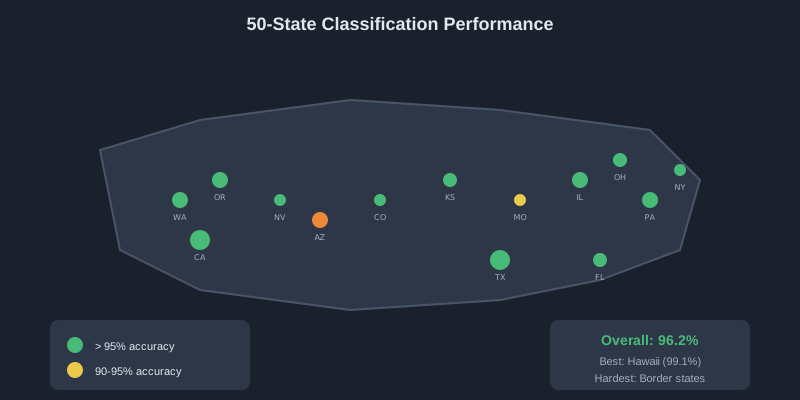 Classification performance across US states - higher accuracy in distinctive regions like Hawaii and Alaska.
Results
Final Performance
- Individual Best (CLIP): 0.906 accuracy
- Ensemble (7 models): 0.96+ accuracy
- Improvement from ensemble: +5.4% absolute
Interesting Failure Cases
The model struggled with: - Border regions: Areas that look like neighboring states - Generic suburbs: Cookie-cutter developments that could be anywhere - Unusual weather: Snow in typically warm states
Lessons Learned
- Ensemble diversity matters more than ensemble size - 3 diverse models beat 7 similar ones
- CLIP's semantic pretraining is powerful for geographic reasoning
- Test-time augmentation provides consistent 1-2% improvement
- Temperature scaling in ensembles helps calibrate confidence
What's Next
This project opened up several research directions: - Hierarchical prediction: Predict region → state → city - Attention visualization: What features does the model use? - Cross-country generalization: Can a US model work for Europe?
The code and models are available on GitHub.
This project was completed as part of CS-GY 6643 Computer Vision at NYU Tandon School of Engineering.